When the Jar Runs Empty


1 Kings 17:14 : “For thus saith the LORD God of Israel, The barrel of meal shall not waste, and the cruse of oil shall not fail.”


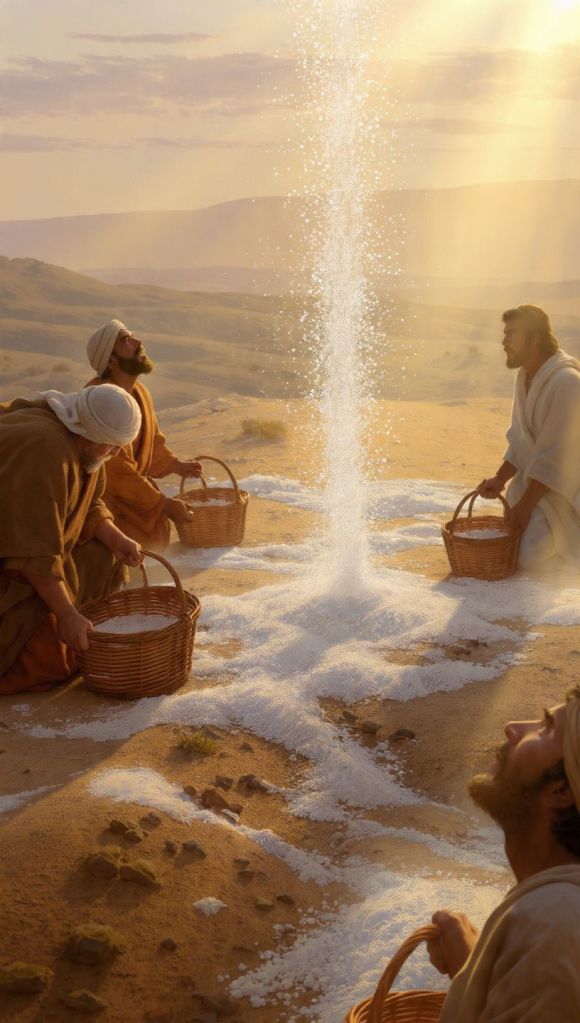
The widow of Zarephath had enough for one last meal. She was gathering sticks to cook it …a final act of provision for herself and her son before they waited to die. And into that specific, desperate, mathematically impossible moment, God sent a prophet with a promise.
Make me a cake first. Then make for yourself and your son.
It is the most counterintuitive instruction imaginable. Give from the last of what you have. Feed a stranger before you feed yourself. Trust a word from God when your pantry is already empty.
She obeyed. And the barrel did not empty. Not that week, not that month … for as long as the drought lasted, the meal did not run out and the oil did not fail. God honored a widow’s obedience by multiplying what she could not afford to give.
The miracle was not in the barrel. The miracle was in the giving.
When you feel you are down to your last … your last strength, last resource, last measure of faith …there is a principle buried in this story worth holding onto. God’s provision often flows through the act of giving what you are most afraid to release.
The jar does not run empty when God is the one sustaining it.
The Lord Is My Shepherd


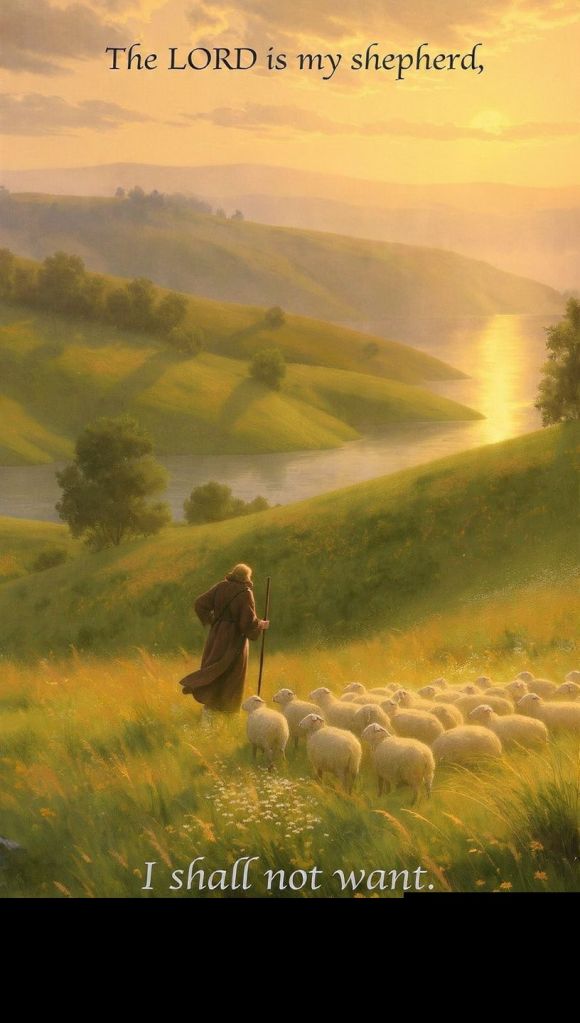
Psalm 23:1 : “The LORD is my shepherd; I shall not want.”


Six words carry the full weight of a life without anxiety. I shall not want. Not I shall not suffer. Not I shall not face difficulty. Not I shall not go through dark valleys … because the valley of the shadow of death comes three verses later. But want …the gnawing, restless, grasping hunger for what you do not have … that is the thing David says he is free from.
Because of who the Shepherd is.
A shepherd in the ancient world was not a romantic figure. He was a working man …. calloused hands, knowledge of terrain, intimate familiarity with each animal under his care. He went ahead to find safe pasture. He stayed behind to find the one that wandered. He lay down in the gap of the sheepfold at night so that nothing could enter or exit without crossing over him.
That is the One David calls his shepherd.
The peace of Psalm 23 is not the peace of someone who has no problems. It is the peace of someone who knows who is walking with them through the problems. The green pastures and still waters are real … but so is the rod and the staff, carried through the valley.
You shall not want. Not because life will be perfect. But because your Shepherd is.

The Last Shall Be First


Matthew 20:16 : “So the last shall be first, and the first last: for many be called, but few chosen.”


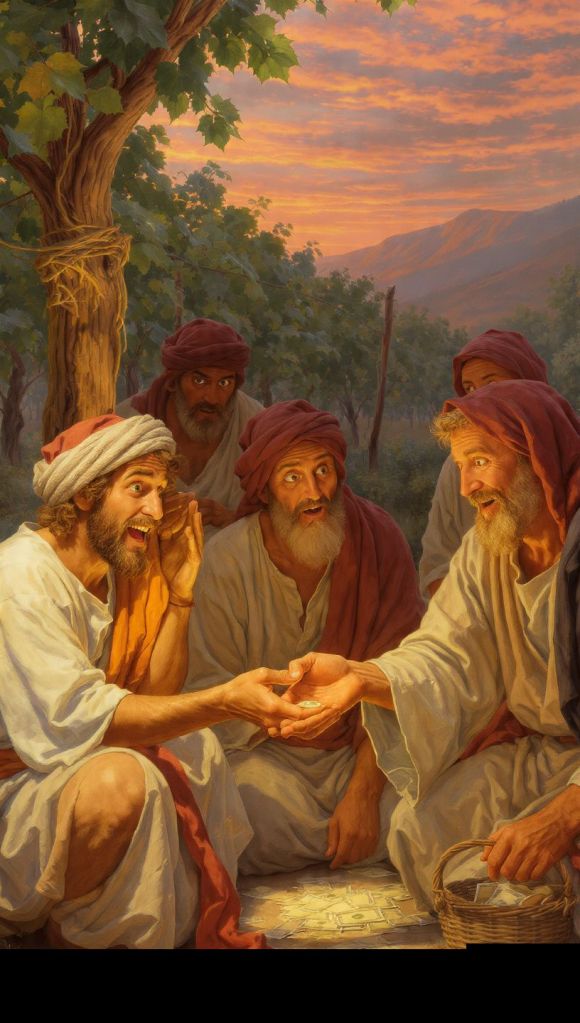
The workers who came at the eleventh hour received the same wage as those who had labored since dawn. It offended the early risers …and Jesus knew it would. That was the point.


The economy of the Kingdom does not run on the same ledger as the economy of the world.
In the world, first mover advantage is real. Seniority has privilege. Those who showed up earliest, worked longest, sacrificed most … they are owed more. That logic is not wrong in human systems. But Jesus is describing a different system entirely, governed not by merit accumulation but by the scandalous generosity of the Owner.


This parable confronts two errors simultaneously. The first is the error of the latecomer who assumes grace is unavailable to them …that they have arrived too late, sinned too much, wasted too many years. They have not. The eleventh hour worker was welcomed fully.


The second is the error of the early worker who mistakes length of service for superiority of standing …. who expects God to be more impressed with them than with the one who just arrived.


Grace levels the field in a way that offends pride and rescues despair simultaneously.
Wherever you are in the line …first, last, or somewhere in the middle …the wage is the same. His name is Jesus.

A Future and a Hope


Jeremiah 29:11 : “For I know the thoughts that I think toward you, saith the LORD, thoughts of peace, and not of evil, to give you an expected end.”


This verse was written to people in captivity. Not people thriving in the Promised Land. Not people in a season of breakthrough and blessing. People sitting in Babylon …exiled, displaced, wondering if God had forgotten the address of where they ended up.
And into that specific darkness, God speaks this specific promise.


I know the thoughts I think toward you. Not thought. Thoughts … plural, ongoing, continuous. God’s mind toward you is not a single fixed opinion formed long ago. It is an active, present engagement with your life … and the content of those thoughts is peace, not evil. A future. A hope.


Do not lift this verse out of its context and drain it of its power. It was written to the suffering. It was delivered to the exiled. It was spoken precisely to the people who had the most reason to doubt it.


That is what makes it extraordinary. God does not reserve His promises for the people whose circumstances already look promising. He speaks future and hope into the places that look most like neither.


You are not in Babylon by accident, and you are not there without a promise. He knows the thoughts He thinks toward you.
They are good.

Enough for Today


Exodus 16:4 : “Then said the LORD unto Moses, Behold, I will rain bread from heaven for you; and the people shall go out and gather a certain rate every day.”

A certain rate. Every day. Not a week’s supply. Not a month’s reserve. Enough for today … and a double portion on the sixth so the seventh could rest.
God built the lesson into the food itself.
Manna could not be hoarded. Those who gathered too much found it rotted by morning. The only way to receive it was daily …which meant the only way to live in the wilderness was in a constant, renewable dependency on God.
We are uncomfortable with that kind of dependency. We prefer reserves. We like knowing the pantry is full, the account is padded, the plan is airtight. There is nothing wrong with wisdom and preparation … but when our security lives entirely in our stockpile rather than in our Provider, we have stopped practicing the faith that the wilderness was designed to build.
Daily bread is not a poverty model. It is a intimacy model. It keeps you returning. It keeps the relationship active. It ensures you never go a day without needing …and therefore never go a day without receiving.
Your manna is waiting for today. Go gather it.

Instructions for the Anxious Heart


Philippians 4:6 : “Be careful for nothing; but in every thing by prayer and supplication with thanksgiving let your requests be made known unto God.”


Be careful for nothing. The King James rendering is stark and almost shocking …. nothing. Not “be careful for less.” Not “try not to worry too much.” Nothing. Not one thing on the list of everything that keeps you awake deserves the full weight of your anxiety.
But Paul does not simply say stop worrying and leave you standing there. He gives you somewhere to put it.
Prayer. Supplication. Thanksgiving. Three movements, all aimed at the same God. Bring the request. Bring the specific need beneath the request. And bring gratitude … not as performance but as the act of remembering who you are bringing it to.
Thanksgiving reorients the heart before the answer arrives. It says: I know who You are. I have seen what You have done. I trust what I cannot yet see. That posture ….grateful before the resolution …is the posture in which peace arrives.
And the peace Paul promises in the next verse is staggering. It passes understanding …. meaning it does not make rational sense given your circumstances. It guards your heart and mind like a soldier posted at the door.
That peace is available to you. The door to it is prayer. Walk through it ….with everything, holding nothing back, dressed in gratitude.

The Stone the Builders Refused


Psalm 118:22 : “The stone which the builders refused is become the head stone of the corner.”

The builders looked at it and said no. Too rough, perhaps. Wrong shape. Doesn’t fit the vision. Set it aside …we’ll find something more suitable.
And God picked it up and made it the cornerstone.
This is one of the most repeated principles in all of scripture, echoed from the Psalms to the Gospels to the letters of Peter … that what men reject, God redeems. That the discarded becomes the defining. That the one passed over becomes the one everything else is built upon.
If you have been rejected …by an institution, by an opportunity that seemed certain and then disappeared … this verse is not a consolation prize. It is an architectural principle. God specializes in taking what the builders refused and putting it in the most important position in the structure.
Your rejection is not your verdict. It is someone else’s limitation, dressed up as your disqualification.
The cornerstone was never lost. It was waiting for the Builder who knew exactly where it belonged.

What Worry Cannot Add

Matthew 6:27 : “Which of you by taking thought can add one cubit unto his stature?”


Jesus asks this with the calm precision of someone who already knows the answer. Not one of you. Not the most anxious among you. Not the most disciplined worrier. Not the person who has elevated anxiety to an art form.
None of you.
Worry is perhaps the most exhausting activity that produces the least result. It costs everything 

. sleep, peace, presence, health …and changes nothing. It is the tax we pay on a future we cannot control, levied by a mind that refuses to rest in the hands of a God who already holds it.
Jesus does not rebuke the worried person harshly. He reasons with them gently. He points to birds and flowers …. creatures that do not file contingency plans, do not run projections, do not lie awake cataloguing worst-case scenarios .

and yet they are fed and clothed by a Father who notices them.
How much more does He notice you?
The antidote to worry is not willpower. It is not positive thinking. It is a reorientation of trust ….a daily, sometimes hourly decision to place the uncontrollable back into the hands of the One who controls it.
Your stature will not change by thinking about it. But your peace will change when you stop trying.

The Night Shift of Faith


Psalm 30:5 : “Weeping may endure for a night, but joy cometh in the morning.”


This verse does not say weeping is wrong. It does not rush you out of grief or hand you a forced smile and call it faith. It simply tells you the truth about time … that night, however long it stretches, is not the permanent condition.
Morning is coming.


There is something important in the word endure. Weeping endures ….meaning it has weight, it has presence, it takes something out of you. God does not minimize the night by promising the morning. He honors the darkness by naming it honestly while refusing to let it have the final word.
The night shift of faith is the hardest assignment. It is the season when you cannot see what God is doing, cannot feel what you used to feel, cannot manufacture the certainty that everything will be alright. You simply have to hold on until the light changes.
But light always changes. That is what light does.


Joy is not destroyed by your weeping. It is waiting on the other side of it …patient, certain, already scheduled. The morning is not a maybe. It is a promise from a God who invented the sunrise.
Hold on through the night. Morning has never once failed to arrive.

The God Who Sees You


Genesis 16:13 : “And she called the name of the LORD that spake unto her, Thou God seest me.”


Hagar did not expect to be found. She was a servant …. not a patriarch, not a prophet, not someone whose name would anchor a covenant. She was running, alone, in a wilderness she had not chosen, carrying a child no one seemed to want her to have.
And God showed up anyway.


Not to a king. Not in a temple. Not during a feast or a formal moment of worship. In the desert. To a woman the world had discarded. And the name she gave Him in that moment became one of the most intimate titles in all of scripture …. El Roi. The God who sees.
You may feel invisible right now. Overlooked by people who should have noticed. Passed over for the recognition you deserved. Sitting in a wilderness of your own …not because you sinned your way there but simply because life took a turn and nobody seemed to follow you into it.


But Hagar’s story insists on something the wilderness cannot disprove: God sees. Not your performance. Not your polished moments. You ….in the running, in the desert, in the place you never planned to be.
He saw Hagar before she called His name. He sees you now.