Come as You Are


Isaiah 1:18 : “Come now, and let us reason together, saith the LORD: though your sins be as scarlet, they shall be as white as snow.”

God does not say get clean, then come. He says come ….and then describes what happens to the scarlet when it arrives in His presence.
The invitation precedes the transformation. You do not clean yourself up to qualify for the conversation. You bring the scarlet … the full weight of it, the exact shade of it, the specific history of it … and God reasons with you about what to do with it.


Scarlet was the color that did not come out. In the ancient world it was a permanent dye …. the kind that set into the fabric and stayed. The kind no amount of washing removed. And God takes that specific metaphor and says: that is what I work with. That is the raw material of My grace.


White as snow. Not pink with effort. Not cream with time. White … as if the scarlet had never been there.
This is not cheap grace that ignores the weight of sin. It is extravagant grace that absorbs it entirely. The reasoning God invites is not a defense of your record. It is a surrender of it.
Come as you are. Leave as something entirely new.


The Good Work He Started


Philippians 1:6 : “Being confident of this very thing, that he which hath begun a good work in you will perform it until the day of Jesus Christ.”

He started it. That is the anchor of the promise. Not you …not your discipline, not your consistency, not your spiritual track record. He began the work. And what God begins, God completes.


The confidence Paul describes is not confidence in the Philippians’ ability to maintain their growth. It is confidence in the character of the One doing the growing. A God who starts things and leaves them unfinished is not the God of scripture. He is a finisher … of faith, of creation, of the work He initiates in human hearts.


This matters enormously when you look at yourself and see how far you still have to go. When the gap between who you are and who you feel called to be seems impossibly wide. When you have failed the same test for the hundredth time and wonder if transformation is actually available to you.
You did not begin this work. You cannot be responsible for finishing it. Your job is cooperation …showing up, surrendering, remaining in the process. His job is completion.


He has not abandoned the project. You are still in the hands of the One who started what He always intended to finish.
Trust the Craftsman.

Love That Will Not Let Go


Romans 8:38-39 : “For I am persuaded, that neither death, nor life, nor angels, nor principalities, nor powers, nor things present, nor things to come, nor height, nor depth, nor any other creature, shall be able to separate us from the love of God.”


Paul builds the list carefully … as if anticipating every argument your fear might raise. Death? No. Life? No. Angels, powers, things happening right now, things coming in the future? No, no, no, and no. Height …the highest you could climb … and depth … the lowest you could fall?
Still no.
Nothing in the created order can sever what God has joined. The love of God in Christ is not a conditional arrangement that requires your consistent performance to remain in effect. It is not a contract that expires when you fail. It is not a feeling that fluctuates with your spiritual temperature.
It is a bond that the entire universe cannot break.
This matters most not when life is good but when the evidence seems to argue against it. When you feel abandoned, distant, unworthy, forgotten. When the circumstances of your life look nothing like the life of someone who is loved by God.
Paul wrote this from prison. He was persuaded anyway.
You are not separated from that love. Not by what you have done, not by what has been done to you, not by what is coming that you cannot yet see.
Nothing. Not one thing.

The Sower and the Soil


Mark 4:20 : “And these are they which are sown on good ground; such as hear the word, and receive it, and bring forth fruit, some thirtyfold, some sixty, and some an hundred.”


Three kinds of soil fail. The path, where the word is taken before it can root. The rocky ground, where enthusiasm blooms fast and dies faster. The thorny ground, where the word is real but the cares of the world and the deceitfulness of riches choke it slowly until it produces nothing.


And then there is good ground. Which hears. Receives. And bears fruit … not uniformly, not competitively, but genuinely. Thirty, sixty, a hundred .. all of it fruit, all of it acceptable, all of it the result of the same seed landing in soil that was prepared to receive it.
The parable is not primarily about the sower or the seed. The seed is the same in every scenario. The sower sows it the same way. The variable ….the only variable …. is the condition of the soil.
And soil can be tended.
Hearts do not have to remain rocky or thorny. The hard path can be broken up. The stones can be removed. The thorns can be pulled. It is slow work, often painful work …but it is the work that determines what kind of harvest your life will produce.
What does your soil look like today?

The Armor and the Battle


Ephesians 6:12 :”For we wrestle not against flesh and blood, but against principalities, against powers, against the rulers of the darkness of this world.”


Your real enemy is not your difficult coworker. Not your estranged family member. Not the person who wronged you, the institution that failed you, or the circumstance that derailed your plans. These may be instruments of conflict ….but they are not the source of it.


Paul pulls back the curtain on a battle happening at a level the natural eye cannot see. And understanding the level of the battle determines how you fight it.


When we mistake the instrument for the enemy, we direct our warfare at people … through bitterness, retaliation, manipulation, or withdrawal. None of these weapons work because none of them address the actual conflict. You cannot win a spiritual war with emotional ammunition.


The armor Paul describes in the surrounding verses is entirely defensive and offensive in spiritual terms ..truth, righteousness, peace, faith, salvation, the Word of God, prayer. Not strategy sessions. Not political maneuvering. Not social leverage.


The most powerful thing you can do in a season of conflict is get on your knees. Not because it is passive … but because it is fighting at the right level.
Know your enemy. Fight accordingly.

He Restores


Psalm 23:3 :”He restoreth my soul.”


Not he improves my soul. Not he polishes my soul. He restores it …which implies the soul had been in a state of disrepair. Worn down. Depleted. Wandered from where it belonged.
Restoration is a different work than construction. It assumes something was once whole and has since been broken. It means God is not building you from scratch … He is bringing you back to what you were always meant to be.

There is a particular tenderness in this promise for those who feel they have strayed too far, lived too long outside the pasture, accumulated too much damage to be worth restoring. Restorers work with the original design in mind. They do not discard what is broken …they study it, treat it carefully, coax it back toward wholeness.


The Good Shepherd does not look at your depleted, wandered soul and start over with something new. He restores this one …the actual one, the one with the history and the scars and the long road back.


He leads you in paths of righteousness after He restores you. The restoration comes first.
You do not have to be fully healed to be led. Let Him restore you on the road.

Salt and Light


Matthew 5:13-14 : “Ye are the salt of the earth… Ye are the light of the world.”


Jesus does not say become salt and light. He says you are. Present tense. Declarative. Not an aspiration …. an identity.


Salt in the ancient world was not primarily a flavoring agent. It was a preservative. It kept things from rotting. It pushed back decay. When Jesus calls His followers salt, He is describing a people whose very presence changes the environment around them … not through conquest but through character, not through volume but through nature.


Light works the same way. It does not argue with darkness. It does not negotiate with it or compete against it. It simply is ….and the darkness recedes. A city on a hill does not try to be seen. Its position makes concealment impossible.


The calling here is not to be louder. It is to be truer. To be so genuinely and consistently yourself …the self God made and redeemed … that your presence has an effect you may not even be fully aware of.


You are preserving something in your workplace, your family, your neighborhood simply by being there and being faithful.
Do not lose your saltiness. Do not hide under a bowl.
The world needs what you already are.

When the Jar Runs Empty


1 Kings 17:14 : “For thus saith the LORD God of Israel, The barrel of meal shall not waste, and the cruse of oil shall not fail.”


The widow of Zarephath had enough for one last meal. She was gathering sticks to cook it …a final act of provision for herself and her son before they waited to die. And into that specific, desperate, mathematically impossible moment, God sent a prophet with a promise.
Make me a cake first. Then make for yourself and your son.
It is the most counterintuitive instruction imaginable. Give from the last of what you have. Feed a stranger before you feed yourself. Trust a word from God when your pantry is already empty.
She obeyed. And the barrel did not empty. Not that week, not that month … for as long as the drought lasted, the meal did not run out and the oil did not fail. God honored a widow’s obedience by multiplying what she could not afford to give.
The miracle was not in the barrel. The miracle was in the giving.
When you feel you are down to your last … your last strength, last resource, last measure of faith …there is a principle buried in this story worth holding onto. God’s provision often flows through the act of giving what you are most afraid to release.
The jar does not run empty when God is the one sustaining it.

The Lord Is My Shepherd


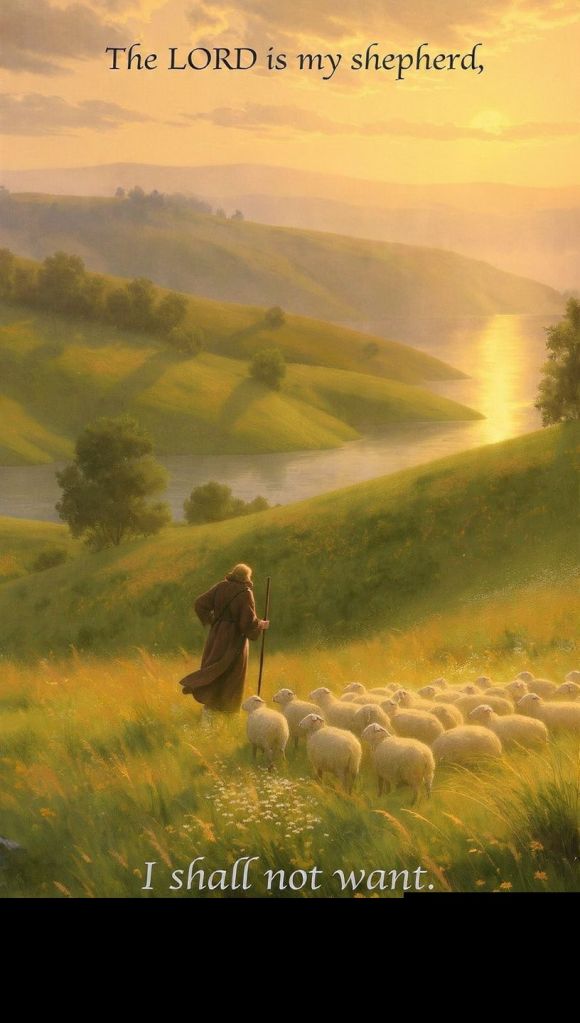
Psalm 23:1 : “The LORD is my shepherd; I shall not want.”


Six words carry the full weight of a life without anxiety. I shall not want. Not I shall not suffer. Not I shall not face difficulty. Not I shall not go through dark valleys … because the valley of the shadow of death comes three verses later. But want …the gnawing, restless, grasping hunger for what you do not have … that is the thing David says he is free from.
Because of who the Shepherd is.
A shepherd in the ancient world was not a romantic figure. He was a working man …. calloused hands, knowledge of terrain, intimate familiarity with each animal under his care. He went ahead to find safe pasture. He stayed behind to find the one that wandered. He lay down in the gap of the sheepfold at night so that nothing could enter or exit without crossing over him.
That is the One David calls his shepherd.
The peace of Psalm 23 is not the peace of someone who has no problems. It is the peace of someone who knows who is walking with them through the problems. The green pastures and still waters are real … but so is the rod and the staff, carried through the valley.
You shall not want. Not because life will be perfect. But because your Shepherd is.

The Last Shall Be First


Matthew 20:16 : “So the last shall be first, and the first last: for many be called, but few chosen.”


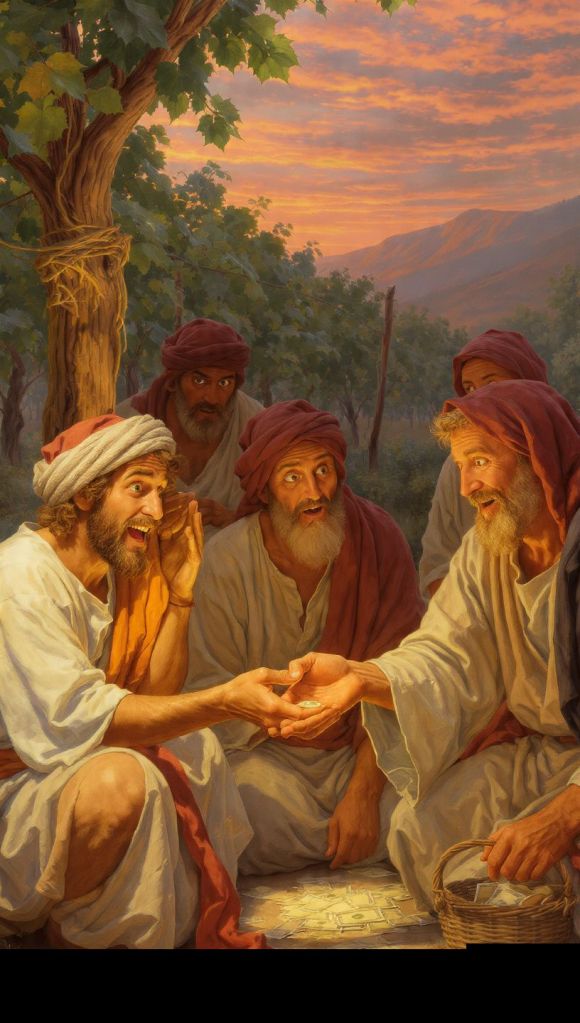
The workers who came at the eleventh hour received the same wage as those who had labored since dawn. It offended the early risers …and Jesus knew it would. That was the point.


The economy of the Kingdom does not run on the same ledger as the economy of the world.
In the world, first mover advantage is real. Seniority has privilege. Those who showed up earliest, worked longest, sacrificed most … they are owed more. That logic is not wrong in human systems. But Jesus is describing a different system entirely, governed not by merit accumulation but by the scandalous generosity of the Owner.


This parable confronts two errors simultaneously. The first is the error of the latecomer who assumes grace is unavailable to them …that they have arrived too late, sinned too much, wasted too many years. They have not. The eleventh hour worker was welcomed fully.


The second is the error of the early worker who mistakes length of service for superiority of standing …. who expects God to be more impressed with them than with the one who just arrived.


Grace levels the field in a way that offends pride and rescues despair simultaneously.
Wherever you are in the line …first, last, or somewhere in the middle …the wage is the same. His name is Jesus.