Falling and Rising


Proverbs 24:16:
“For a just man falleth seven times, and riseth up again: but the wicked shall fall into mischief.”


Righteousness in Scripture was never about never falling … it’s about always getting back up. Seven, a number of completeness, suggests repeated failure, again and again, and yet the just person keeps rising. The difference isn’t the absence of failure; it’s the presence of resilience rooted in God.
If you’re carrying shame over a repeated failure, this verse reframes it: falling isn’t disqualifying. Staying down is the danger. Get up again today.


Prayer: Father, when I fall today, give me the grace to rise again instead of staying down in shame. Amen.

Right in Our Own Eyes


Proverbs 21:2:
“Every way of a man is right in his own eyes: but the LORD pondereth the hearts.”


Nearly identical to Proverbs 16:2 and 12:15, this repeated theme should catch our attention by now: we are terrible judges of our own motives. We justify, rationalize, and feel entirely correct … while God, who ponders hearts, sees the actual truth beneath the justification.
This isn’t meant to produce paralysis or self-doubt about everything. It’s meant to produce humility …an ongoing willingness to ask God to examine motives we can’t fully see in ourselves.


Prayer: Lord, You ponder my heart more accurately than I ever could. Show me what I can’t see about myself. Amen.

Running to the Strong Tower


Proverbs 18:10:
“The name of the LORD is a strong tower: the righteous runneth into it, and is safe.”


A tower in the ancient world wasn’t decorative …it was defense, a place you fled to when the enemy was at the gate. Solomon says God’s own name functions this way: not a slogan, but a literal refuge you can run into.
The verb matters … “runneth.” Not strolls, not eventually gets around to it, but runs, urgently, the way you’d run from real danger. When anxiety or trouble hits today, where do you instinctively run first …. to distraction, to worry, to control? Practice running to Him instead.


Prayer: God, be my strong tower today. When trouble comes, let my first instinct be to run to You. Amen.

Guard the Control Center


Proverbs 4:23:
“Keep thy heart with all diligence; for out of it are the issues of life.”


The heart, in Hebrew thought, wasn’t just the seat of emotion….it was the control center of the whole person: thoughts, will, desires, decisions. Solomon is saying: guard that control center like a city guards its gates, because everything else in your life flows out from there.
This is why chasing behavior change without heart change so often fails. You can white-knuckle a habit for a while, but if the heart underneath is unguarded, the old pattern resurfaces. What are you letting into your heart today ….through what you watch, read, or dwell on? Diligence means active, ongoing effort, not a one-time decision.


Prayer: Father, show me what I’ve let into my heart unguarded. Help me tend to it with the diligence You ask for. Amen.

The Refiner’s Fire


Malachi 3:3 : “And he shall sit as a refiner and purifier of silver: and he shall purify the sons of Levi, and purge them as gold and silver.”


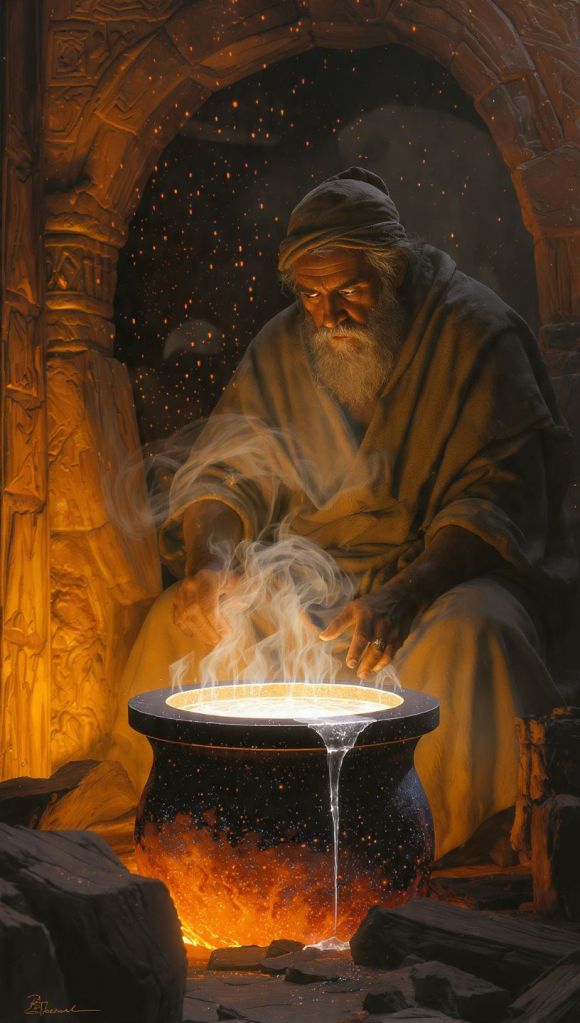
A refiner does not heat silver to destroy it. He heats it to reveal it … to bring the impurities to the surface where they can be skimmed away, leaving behind the metal in its purest form. The fire is not punishment. It is process.
And crucially … the refiner sits. He does not walk away and leave the silver unattended in the heat. He stays. He watches. He knows the exact moment the metal has been purified enough …. and that moment is when he can see his own reflection in it.
God’s refining work in your life follows the same principle. The difficult seasons …. the ones that apply heat, that surface what you would rather keep hidden, that burn away what you have been holding onto … are not abandonment. They are attended. He is sitting with you in them, watching carefully, never letting the temperature exceed what the work requires.
And the goal is reflection. That when the process is complete, your life would mirror His character clearly enough that He can see Himself in you.
The fire means you are not forgotten. It means you are being refined.
Trust the Refiner. He knows what He is doing …. and He has not left the room.

The Secret Place


Psalm 91:1 : “He that dwelleth in the secret place of the most High shall abide under the shadow of the Almighty.”


There is a place described here that is not on any map. It cannot be reached by ambition or acquired by achievement. It is not earned through spiritual performance or unlocked after a certain number of years in faith.
It is found through dwelling … which is not a dramatic act but a habitual one. The dwelling is the practice of remaining in the presence of God not just in crisis but in the ordinary texture of daily life. Prayer as conversation, not only petition. Scripture as nourishment, not only instruction. Worship as posture, not only event.
The shadow of the Almighty is a specific image. Shadow requires proximity. You cannot be in someone’s shadow from across the room. To dwell in that shadow is to stay close … close enough that His presence is between you and whatever comes at you.
The protection described in the rest of Psalm 91 is not magic. It is the natural overflow of proximity. The safest place in any storm is close to the One who commands it.
Where are you dwelling today? In the worry? In the noise? In the constant motion of productivity?
Come back to the secret place. It is quieter there …. and safer.

The Good Work He Started


Philippians 1:6 : “Being confident of this very thing, that he which hath begun a good work in you will perform it until the day of Jesus Christ.”

He started it. That is the anchor of the promise. Not you …not your discipline, not your consistency, not your spiritual track record. He began the work. And what God begins, God completes.


The confidence Paul describes is not confidence in the Philippians’ ability to maintain their growth. It is confidence in the character of the One doing the growing. A God who starts things and leaves them unfinished is not the God of scripture. He is a finisher … of faith, of creation, of the work He initiates in human hearts.


This matters enormously when you look at yourself and see how far you still have to go. When the gap between who you are and who you feel called to be seems impossibly wide. When you have failed the same test for the hundredth time and wonder if transformation is actually available to you.
You did not begin this work. You cannot be responsible for finishing it. Your job is cooperation …showing up, surrendering, remaining in the process. His job is completion.


He has not abandoned the project. You are still in the hands of the One who started what He always intended to finish.
Trust the Craftsman.

Salt and Light


Matthew 5:13-14 : “Ye are the salt of the earth… Ye are the light of the world.”


Jesus does not say become salt and light. He says you are. Present tense. Declarative. Not an aspiration …. an identity.


Salt in the ancient world was not primarily a flavoring agent. It was a preservative. It kept things from rotting. It pushed back decay. When Jesus calls His followers salt, He is describing a people whose very presence changes the environment around them … not through conquest but through character, not through volume but through nature.


Light works the same way. It does not argue with darkness. It does not negotiate with it or compete against it. It simply is ….and the darkness recedes. A city on a hill does not try to be seen. Its position makes concealment impossible.


The calling here is not to be louder. It is to be truer. To be so genuinely and consistently yourself …the self God made and redeemed … that your presence has an effect you may not even be fully aware of.


You are preserving something in your workplace, your family, your neighborhood simply by being there and being faithful.
Do not lose your saltiness. Do not hide under a bowl.
The world needs what you already are.

A Future and a Hope


Jeremiah 29:11 : “For I know the thoughts that I think toward you, saith the LORD, thoughts of peace, and not of evil, to give you an expected end.”


This verse was written to people in captivity. Not people thriving in the Promised Land. Not people in a season of breakthrough and blessing. People sitting in Babylon …exiled, displaced, wondering if God had forgotten the address of where they ended up.
And into that specific darkness, God speaks this specific promise.


I know the thoughts I think toward you. Not thought. Thoughts … plural, ongoing, continuous. God’s mind toward you is not a single fixed opinion formed long ago. It is an active, present engagement with your life … and the content of those thoughts is peace, not evil. A future. A hope.


Do not lift this verse out of its context and drain it of its power. It was written to the suffering. It was delivered to the exiled. It was spoken precisely to the people who had the most reason to doubt it.


That is what makes it extraordinary. God does not reserve His promises for the people whose circumstances already look promising. He speaks future and hope into the places that look most like neither.


You are not in Babylon by accident, and you are not there without a promise. He knows the thoughts He thinks toward you.
They are good.

The Whisper After the Wind


1 Kings 19:12 : “And after the earthquake a fire; but the LORD was not in the fire: and after the fire a still small voice.”

Elijah had just called down fire from heaven. He had outrun a chariot. He had watched God move in power so undeniable that even the prophets of Baal could not counter it. And then he collapsed under a tree and asked God to let him die.


The dramatic can exhaust us in ways the ordinary cannot.
God sent an angel with food. Twice. Then told him to travel forty days to a mountain — and when Elijah arrived, still hollow, God did not meet him with wind or earthquake or fire. He met him with a still small voice. A sound of sheer silence. A whisper.


God is not always loudest when He is closest. The spectacular moments are real — but they are not the whole vocabulary of how He speaks. Sometimes, after the storm has passed and the noise has settled and you are sitting in the cave of your own exhaustion wondering if any of it was real, He comes not in the thunder but in the quiet.
You have to be still to hear a whisper. You have to stop performing, stop striving, stop filling the silence with noise.
What if God is speaking right now — and the room just needs to get quieter?